
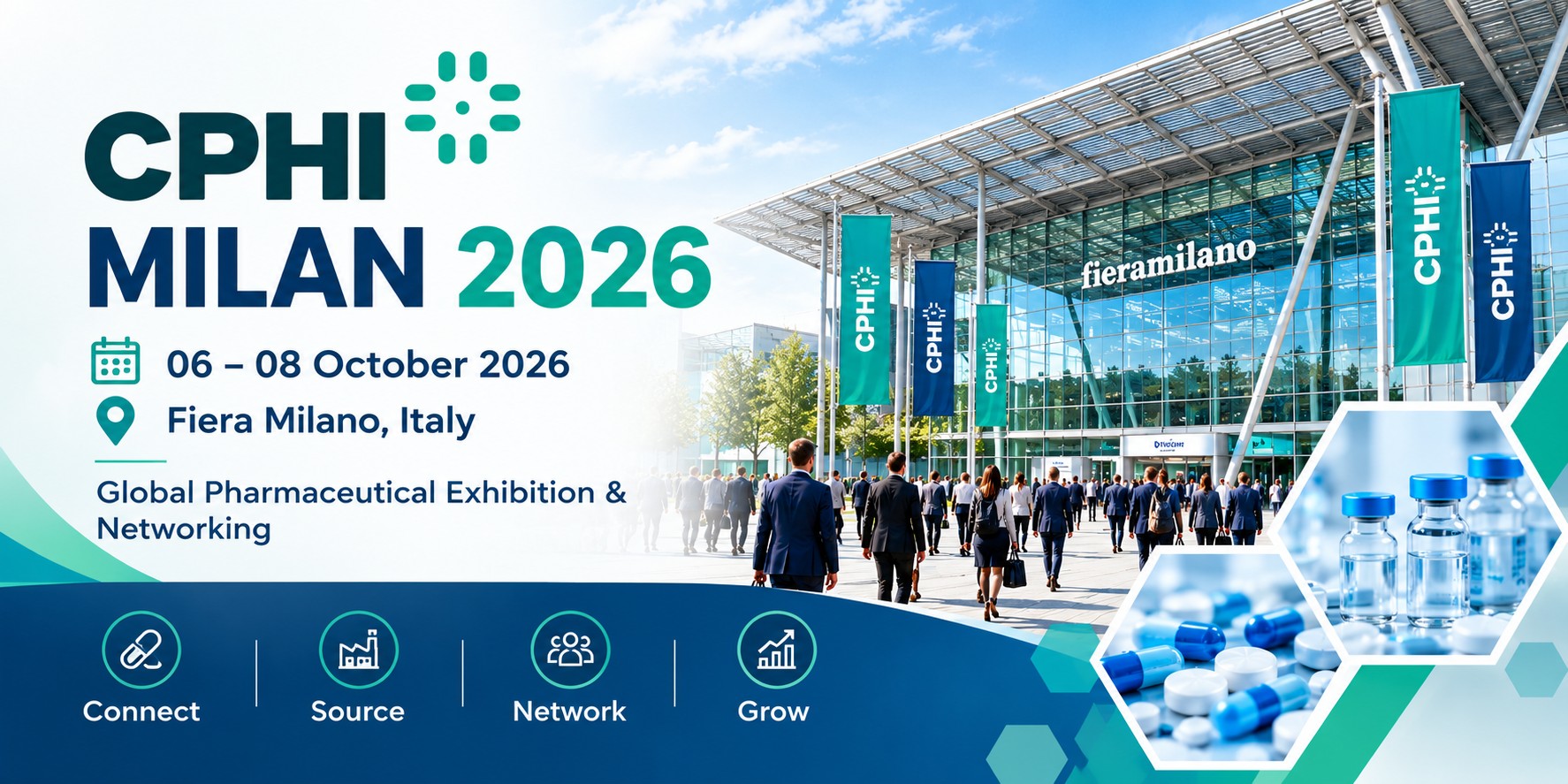
CPHI Milan 2026 will take place from 6–8 October 2026 at Fiera Milano in Rho, Milan, Italy, bringing together professionals and businesses connected with the global pharmaceutical supply chain. The event provides a major meeting point for pharmaceutical manufacturers, suppliers, technology companies, service providers, procurement professionals and international businesses exploring new opportunities across the pharma value chain.
For international pharmaceutical buyers, CPHI Milan 2026 is particularly relevant because pharmaceutical sourcing is no longer limited to finding a product or comparing suppliers. Modern procurement increasingly involves evaluating manufacturing capabilities, supply continuity, documentation, logistics, technology, quality systems and the regulatory requirements of individual markets.
CPHI Milan 2026 at a Glance
| Event Detail | Information |
|---|---|
| Event | CPHI Milan 2026 |
| Dates | 6–8 October 2026 |
| Venue | Fiera Milano |
| Location | Rho, Milan, Italy |
| Industry | Pharmaceutical & Life Sciences |
| Focus | Global Pharmaceutical Supply Chain |
| Audience | Manufacturers, suppliers, buyers, procurement teams, distributors and pharma professionals |
What Is CPHI Milan 2026?
CPHI Milan is a major international pharmaceutical industry exhibition focused on connecting different parts of the pharmaceutical value chain.
The event brings together areas ranging from APIs and finished dosage formulations to bioproduction, contract services, packaging, drug delivery, machinery, technology and other pharmaceutical supply-chain capabilities.
The 2026 edition also expands its scope with new areas addressing emerging priorities in pharmaceutical manufacturing and supply.
For businesses involved in international pharmaceutical procurement, this makes CPHI Milan relevant not only as an exhibition but also as a platform for understanding where pharmaceutical sourcing, manufacturing and supply-chain strategies are heading.
Why CPHI Milan 2026 Matters to International Pharmaceutical Buyers
International pharmaceutical procurement is becoming increasingly complex.
A buyer may need to evaluate:
- Product availability
- Manufacturer capabilities
- Manufacturing location
- Quality documentation
- Regulatory requirements
- Packaging specifications
- Minimum order requirements
- Supply continuity
- Temperature requirements
- Transportation options
- Import documentation
- Delivery planning
CPHI Milan brings many of these parts of the pharmaceutical ecosystem into one environment.
For importers, distributors, wholesalers, hospitals and institutional procurement teams, the event can therefore provide useful insight into supplier capabilities and emerging pharmaceutical business models.
Exploring the Global Pharmaceutical Supply Chain
One of the strongest aspects of CPHI Milan is its coverage of multiple stages of the pharmaceutical value chain.
APIs & Pharmaceutical Ingredients
Active pharmaceutical ingredients remain fundamental to medicine manufacturing. Buyers and manufacturers can evaluate sourcing opportunities, production capabilities and ingredient supply requirements.
Finished Dosage Formulations
Finished dosage manufacturers cover products prepared for market distribution, including different pharmaceutical formulations and delivery formats.
Contract Manufacturing & Services
Contract manufacturing and development partnerships can help pharmaceutical businesses access specialised capabilities without building every manufacturing function internally.
Bioproduction
Biological medicines require specialised manufacturing, technology and quality considerations. Bioproduction is therefore an increasingly important part of the global pharmaceutical ecosystem.
Packaging & Drug Delivery
Packaging is not simply a presentation component. Pharmaceutical packaging can influence product protection, handling, transportation and compliance requirements.
Machinery & Technology
Manufacturing technology supports pharmaceutical production, processing, inspection, automation and packaging operations.
These areas form part of CPHI Milan's wider pharmaceutical ecosystem.
New Focus Areas at CPHI Milan 2026
The 2026 edition introduces four new zones that reflect important developments across the pharmaceutical industry.
AI & Technology
Artificial intelligence is increasingly being explored across pharmaceutical research, development, manufacturing and supply-chain operations.
Potential applications include:
- Drug discovery
- Data analysis
- Predictive manufacturing
- Digital twins
- Supply-chain visibility
- Demand forecasting
- Process optimisation
- Commercial analytics
Cold Chain & Logistics
Temperature-sensitive medicines require careful control throughout storage and transportation.
The Cold Chain & Logistics focus is particularly relevant to:
- Temperature-controlled transportation
- Pharmaceutical packaging
- Monitoring systems
- Logistics planning
- Supply-chain integrity
This is especially important for biologics, vaccines and other temperature-sensitive pharmaceutical products.
Contamination Control
Manufacturing environments require controlled processes to protect product quality.
Contamination-control technologies can therefore play an important role in pharmaceutical manufacturing environments, particularly where controlled production conditions are required.
Labelling
Accurate pharmaceutical labelling supports product identification, handling and market-specific requirements.
The addition of labelling as a dedicated 2026 focus reflects the importance of detail and compliance across pharmaceutical packaging and distribution.
Pharmaceutical Sourcing and Procurement at CPHI Milan
For international buyers, one of the most commercially relevant aspects of CPHI Milan is the opportunity to understand the broader supplier ecosystem.
A structured sourcing discussion should consider more than price.
A pharmaceutical buyer may evaluate:
Supplier capability
Can the supplier consistently meet the required specification?
Documentation
Are relevant product and manufacturing documents available?
Regulatory suitability
Does the product and supply arrangement fit the destination market?
Supply capacity
Can the supplier support the expected volume and schedule?
Logistics
Can the required transportation and handling conditions be maintained?
Communication
Can procurement, documentation and shipment requirements be coordinated efficiently?
These considerations become particularly important when pharmaceutical products are being sourced for international markets.
Pharmaceutical Manufacturing and Global Partnerships
CPHI Milan also provides a broader view of how pharmaceutical businesses collaborate across borders.
Partnership models can include:
- Pharmaceutical manufacturing
- Contract manufacturing
- Development services
- API sourcing
- Finished dosage supply
- Packaging partnerships
- Technology solutions
- Logistics services
- Distribution relationships
For international businesses, the value of such partnerships often depends on how well commercial requirements, technical capabilities and regulatory expectations align.
Sustainability and the Future of Pharmaceutical Supply
Sustainability is becoming increasingly relevant across pharmaceutical manufacturing and supply chains.
CPHI Milan 2026 also features the CPHI Sustainability Summit, bringing additional attention to sustainability within the pharmaceutical industry.
Sustainability considerations can extend across:
- Manufacturing
- Packaging
- Transportation
- Energy use
- Supply-chain design
- Waste reduction
- Resource efficiency
For pharmaceutical businesses operating internationally, sustainability is increasingly connected with operational efficiency and long-term supply-chain planning.
CPHI Milan 2026 and International Pharmaceutical Markets
The global pharmaceutical market is not a single uniform market.
Import requirements, product registration, documentation, packaging, labelling and distribution conditions can vary between countries.
International buyers from regions such as:
- Europe
- Middle East
- Africa
- Latin America
- North America
- Southeast Asia
- Other emerging markets
may therefore have different procurement priorities.
A pharmaceutical supplier or sourcing partner needs to understand these differences rather than applying one standard approach to every destination.
India's Role in Global Pharmaceutical Sourcing
India has an established position in international pharmaceutical manufacturing and medicine supply.
For global buyers, Indian pharmaceutical companies can form part of a diversified sourcing strategy for generic medicines and other pharmaceutical requirements.
However, international sourcing should always be evaluated according to the specific product, manufacturer, documentation and destination-market requirements.
For procurement teams, the objective should be to establish a supply relationship that combines appropriate product availability with documentation, quality requirements, logistics planning and regulatory suitability.
Pharmaceutical Sourcing Support for International Buyers
The Indian Pharma works with international pharmaceutical requirements involving sourcing and supply coordination from India and international markets.
Depending on the requirement, procurement discussions may involve:
- Generic medicines
- Specialty medicines
- Oncology medicines
- Rare disease medicines
- Hospital requirements
- Institutional procurement
- Bulk pharmaceutical requirements
- International pharmaceutical sourcing
- Regulatory documentation
- Pharmaceutical logistics
Every requirement is reviewed according to the product, destination, applicable regulations and supply conditions.
Have a Pharmaceutical Requirement?
Share your requirement with The Indian Pharma team for sourcing and supply coordination.
Submit Your Pharmaceutical Requirement
Explore Pharmaceutical Sourcing
Contact The Indian Pharma
What International Buyers Should Prepare Before CPHI Milan 2026
A productive pharmaceutical business meeting usually starts before the exhibition.
International buyers can prepare:
1. Product Requirements
Prepare generic names, strengths, dosage forms and required quantities.
2. Market Information
Identify the destination countries and applicable import requirements.
3. Documentation Requirements
List the certificates and technical documents required for evaluation.
4. Commercial Requirements
Define estimated volumes, target timelines and procurement conditions.
5. Logistics Requirements
Consider temperature conditions, packaging, transportation and delivery requirements.
6. Supplier Evaluation Criteria
Prepare a checklist covering manufacturing capability, documentation, quality and supply continuity.
This makes supplier discussions more focused and commercially useful.
CPHI Milan 2026: Beyond the Exhibition Floor
CPHI Milan 2026 represents more than a three-day exhibition.
The event brings together different parts of the pharmaceutical ecosystem at a time when the industry is dealing with rapid technological development, supply-chain complexity, evolving regulatory expectations and increasing demand for efficient international collaboration.
For pharmaceutical manufacturers, suppliers, procurement teams, distributors and international buyers, the most valuable outcome may not simply be discovering a new product.
It may be discovering a better way to build, source, manufacture, distribute and manage pharmaceutical supply across international markets.
Meet Us at CPHI Milan 2026
Planning to attend CPHI Milan 2026 or looking to discuss a pharmaceutical sourcing requirement?
Schedule a meeting with Ikris Pharma Network during CPHI Milan 2026.
Book a Meeting →
https://ikrispharmanetworkcom.dayschedule.com/cphi-milan-2026-fiera-milano-italy
Discuss Your Pharmaceutical Requirement →
Connect with The Indian Pharma team for international pharmaceutical sourcing and supply coordination.